

This article was written by Chris Urban, an automation educator and PLC trainer with over 40 years of hands-on experience. Find Chris on YouTube and LinkedIn. — CU
Against the popular belief that relays are obsolete and too simple to discuss, there are people who think that after nearly 200 years, the relay is still not fully understood. This article takes a practical look at why the electromagnetic relay — the EMR — remains one of the most important components in industrial automation today.
Where the Word “Relay” Comes From…
Before diving into the technical side, a brief detour into history.
The Normans — Norse Vikings who settled in northern France and founded the duchy of Normandy — eventually conquered England in 1066. That conquest introduced more than 7,000 French words into the English language. The average person today carries about 3,000 words in their active vocabulary. The Normans added more than double that to English in one invasion.
One of those French words was relaier — now relayer — originally meaning the exchange of tired animals for fresh ones. Hunting hounds in the late 14th century, postal horses in the 17th century, and squads of workers taking turns on construction sites in the 19th century. From there: the word relay.
The electromagnetic relay adopted the name around 1860 — well after Joseph Henry’s work on telegraph relays and Edward Davy’s 1837 description of the device as an “Electrical Renewer.” The name stuck. And so did the device.
Sources: Britannica — Norman people · Etymology Online — relay
So why is the relay still successful after nearly 200 years?
Five reasons.
Reason #1 — Low Power Controls High Power
A relay coil requires only tens of milliamps to operate. Even large 30A contactors rarely draw more than 100mA on the coil side. But the contacts those coils control can handle 1A for ultra-miniature relays, 10A to 25A for standard industrial relays, and 100A or more for large contactors.
From this perspective, the relay is a digital power amplifier — a tiny control signal switches a load many times larger than itself.
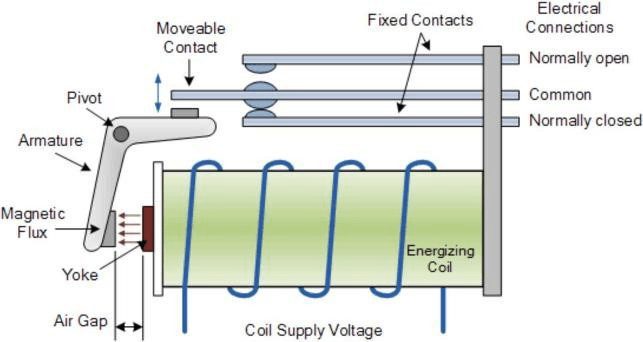
A PCB relay — the type mounted inside PLC output modules. Image source: allaboutcircuits.com
Reason #2 — Galvanic Isolation Between Control and Load
The coil circuit and the contact circuit are electrically isolated from each other. They share a mechanical assembly — but they will never make electrical contact.
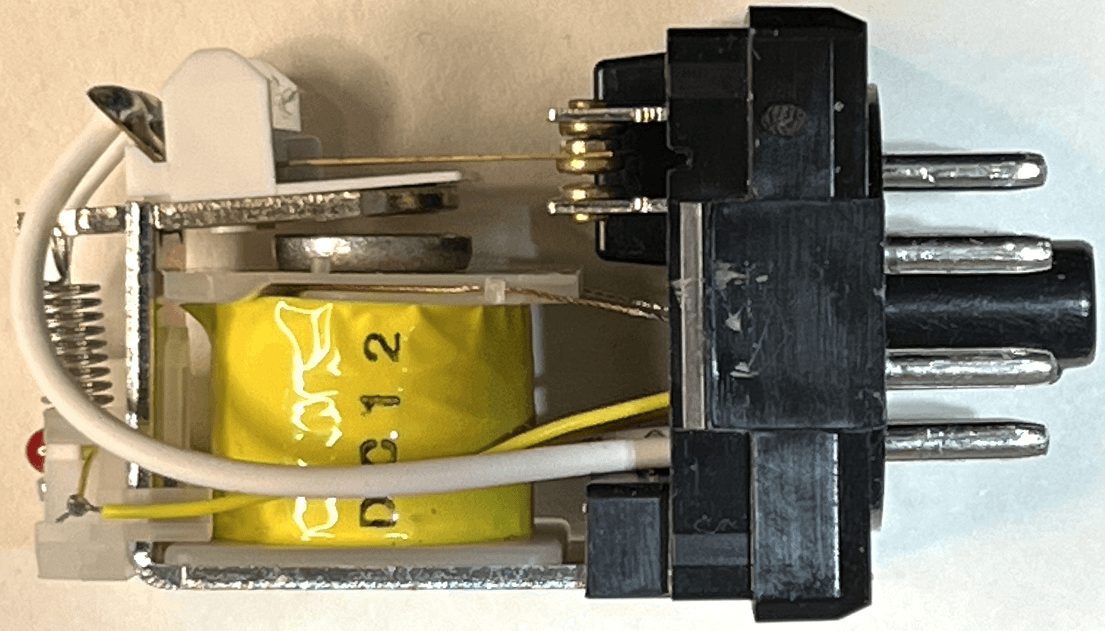
Inside an EMR: the plastic spool with coil winding and the round contacts. The coil and contacts share a mechanical assembly but are electrically isolated. Photo courtesy Chris Urban.
This isolation allows completely different voltages on the control side versus the load side. The coil is typically energised with low DC voltage — 3V, 5V, 6V, 9V, 12V, or 24V are the most common. The output contacts can be connected to DC or AC power sources depending on the load.
Example A — On top of a 3.3V or 5V Arduino board, a 4-relay shield like the DFRobot model gives you access to connect any 12V or 24V DC load. The same principle applies to AutomationDirect’s Productivity series with P1AM-100 or P1AM-200 CPUs.
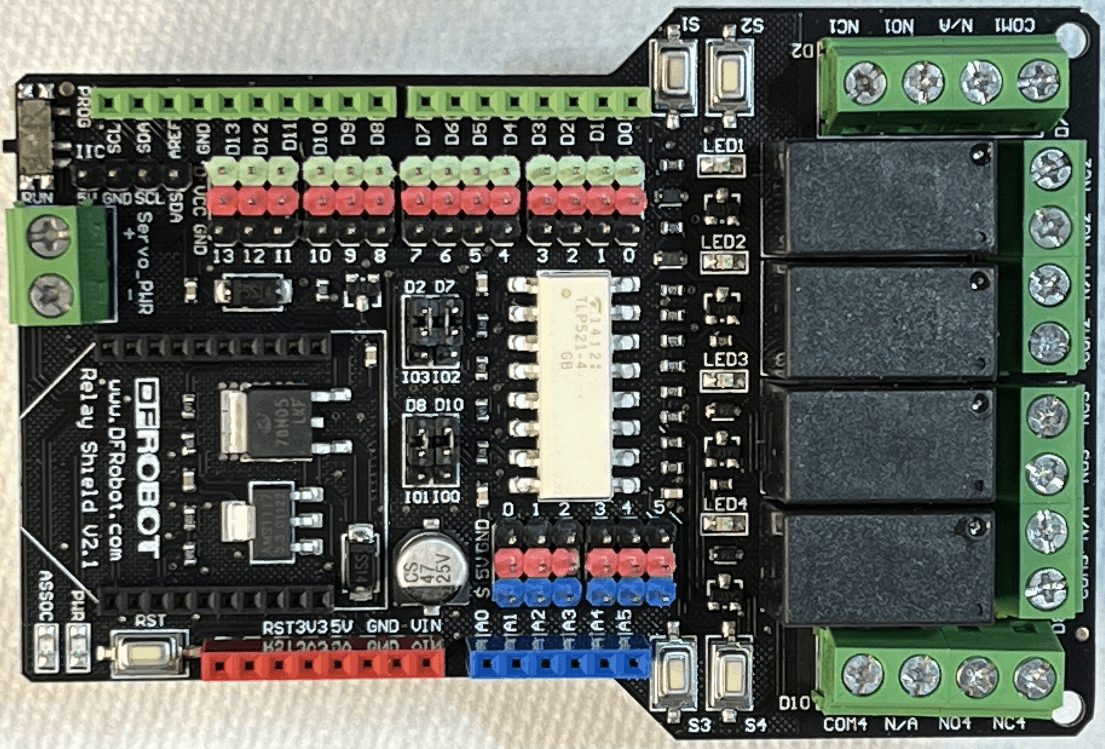
A DFRobot 4-relay shield on an Arduino board — the same relay principle applies to the AutomationDirect Productivity series P1AM-100 and P1AM-200 CPUs. Photo courtesy Chris Urban.
Example B — From the standard 24V DC relay coil of a PLC output module, you can completely control a three-phase motor.
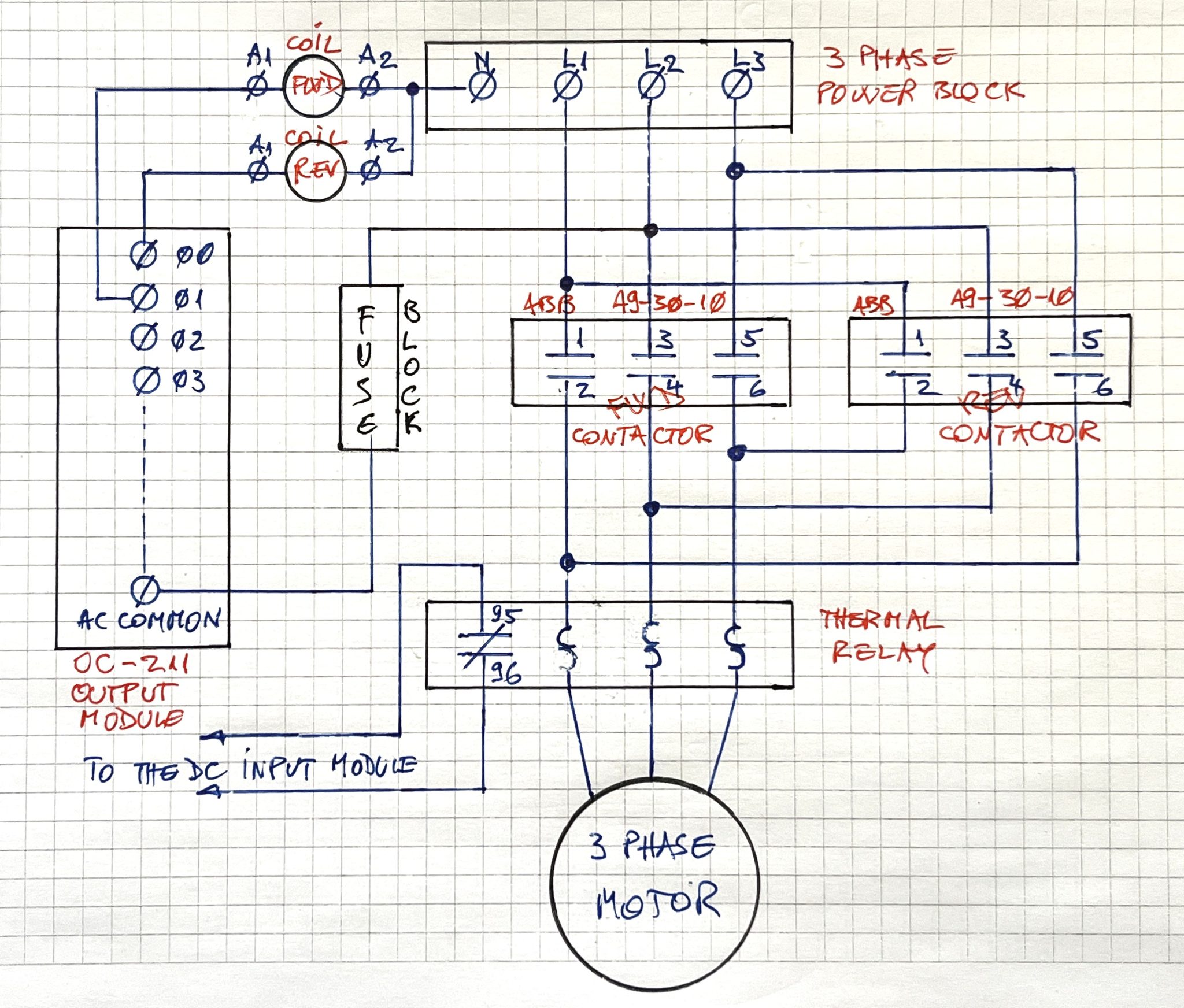
Reason #3 — Boolean Logic and the Birth of Ladder Logic
As Claude E. Shannon proved roughly 90 years ago, relays can be used to build logic circuits that follow Boolean algebra. From Shannon’s mathematical relationships came the RLD — Relay Logic Diagrams — still widely used in industry today. The RLD evolved into the LLD — Ladder Logic Diagrams — used by every PLC programmer and became part of the IEC 61131-3 standard for PLC programming languages.
Every rung of ladder logic you write in the ACC PLC Simulator or on any real PLC has its roots in relay logic. The relay came first. The PLC followed.
Reason #4 — Safety-Critical Applications
After nearly 200 years of development, EMRs have become highly specialized and are almost impossible to fully replace with semiconductor-based alternatives in certain applications. In safety-critical logic, semiconductors are actually less reliable than relays. Control panels for radioactive waste-handling equipment are a practical example in which relay contacts remain the preferred solution.
Reason #5 — Price
Are there better switching devices than EMRs available? Absolutely — BJTs, MOSFETs, SCDs (Silicon Controlled Devices), and SSRs (Solid State Relays) are all smaller, have no moving parts, switch faster, and require far less copper, iron, and silver than an industrial relay.
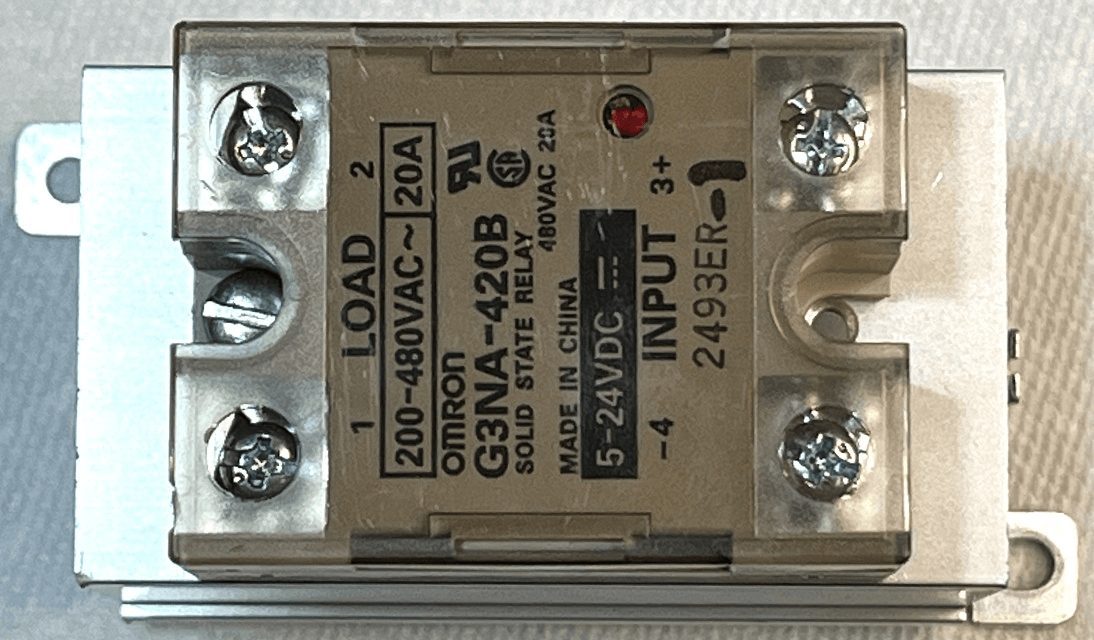
Solid state alternatives to the EMR — smaller, faster, no moving parts. But still not a full replacement for every application. Photo courtesy Chris Urban.
But when you consider all four of the previous reasons together — power amplification, galvanic isolation, Boolean logic capability, and safety-critical reliability — no other electronic component replaces the EMR at a lower price point.
The verdict?
And Still, the Undisputed Electrically Controlled Switch Champion Remains… the EMR!
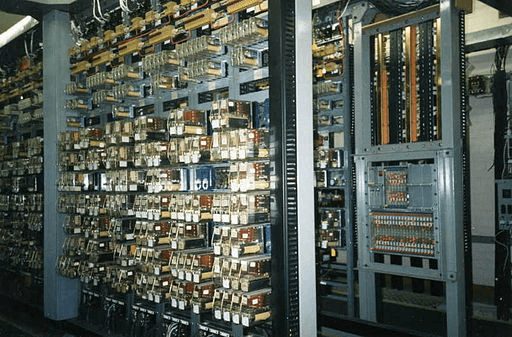
More on relays is coming — Chris has another article in progress covering contacts and connections in more practical detail. Stay tuned.
Want to practice relay output logic in ladder logic without any hardware? Try the free ACC PLC Simulator — runs in your browser, no install required.
About the author: Chris Urban is an automation educator and PLC trainer with over 40 years of hands-on experience. Find him on YouTube and LinkedIn. — CU