This article was written by Chris Urban, an automation educator and PLC trainer with over 40 years of hands-on experience. Find Chris on YouTube and LinkedIn. — CU
This is the fourth article in the relay series. If you missed the previous one, start here:
The Relay Obituary? Not So Fast!
Before diving into how relay contacts are used in industrial applications — which is coming in the next article — it makes sense to define the terms first. Too many of them are misunderstood or misused in practice, and that leads to confusion when reading diagrams or troubleshooting on the floor.
A few disclaimers before we start.
This is not an exhaustive presentation of relay types. The market has developed a huge variety of relays over nearly 200 years, and the industrial applications are practically countless.
The following types will not be covered here — some of them are very particular:
latching relays (which may have one or two coils), reed relays (which have no coils at all, only contacts), thermal relays, safety relays, and solid-state relays, which are not technically relays at all but share the name with EMRs as their modern substitutes.
The focus here is on the most common relays used with PLCs.
A Quick Recap — How the Relay Works
Before getting to the glossary, a brief review of the main parts.
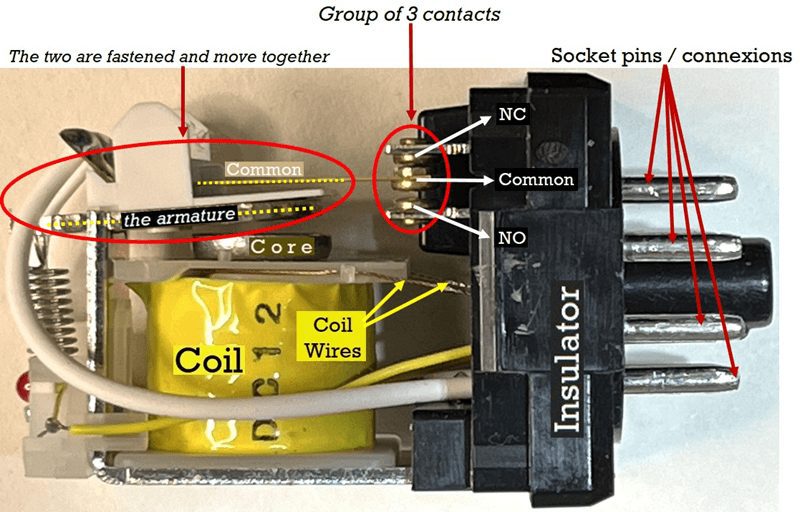
The Common contact is the only moving part — everything else is fixed.
In its normal state, the iron core is not magnetized. As soon as the coil is energized, the iron core becomes a magnet temporarily — hence the name Electromagnetic Relay — and attracts the armature. The two remain together for as long as the coil is energized. When the coil power is cut, the spring returns both the armature and the Common contact to their initial positions.
The important thing to remember is that both the Normally Open and Normally Closed contacts are fixed to the relay frame. The only moving contact is the Common — and it moves because the elastic lever holding it is fastened to the armature. When the armature sticks to the iron core, the lever forces the Common to shift from the NC to the NO contact.
Contact Groups and Symbols
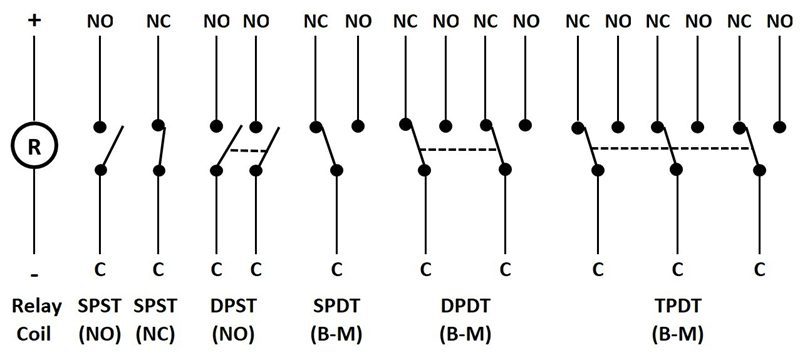
The dotted line connecting multiple groups indicates they are part of the same physical relay and move simultaneously.
When you see a dotted line connecting two or more groups of contacts on a diagram, it means those groups are part of the same physical relay. All poles move simultaneously — you cannot control one group of contacts independently while the others stay still. All NO contacts close at the same time, or none of them do.
The Glossary
Pole — Refers to the moving electrical element of the relay — the lever wearing the Common contact at its end. This is the part that makes electrical contact during operation.
C (Common) — The electric connection of the metallic lever wearing the moving contact.
It is called Common because during relay operation, it is shared between the Normally Open and Normally Closed contacts.
Note: the word ” common ” has several meanings in electronics. In relay terminology, it refers to the moving contact. In circuit diagrams, it usually refers to the common wire connected to the negative of the power supply. Same word, different meaning — context matters.
SPST — Single Pole, Single Throw
SPDT — Single Pole, Double Throw
DPST — Double Pole, Single Throw
DPDT — Double Pole, Double Throw
TPDT — Triple Pole, Double Throw
QPDT — Quad Pole, Double Throw
Throw — Specifies the number of options the Common contact can connect to.
Single Throw means the Common can only shift to the NO contact — the NC contact is simply missing on that relay type. This is the simplest and cheapest relay construction available. It is also the backbone of most PLC output modules. Double Throw means the Common has two options: it can switch between the NC and NO contacts.
Group — The tied assembly of Common + NC + NO contacts on a single pole.
When a diagram shows a dotted line connecting two or more groups, those groups belong to the same physical relay and move together.
B-M (Break Before Make) — A construction characteristic of the relay.
When the coil is energized, the Common contact detaches from the NC before it Makes contact with the NO. For a very short fraction of time — around 10 milliseconds for quick relays — the Common travels through the air between the two contacts. This means the Common Breaks from the NC contact before it Makes contact with the NO. For reference, a transistor switches in around 10 nanoseconds — roughly one million times faster.
NO (Normally Open) — The contact that is open (not connected to Common) when the relay coil is not energized. The word “Normally” refers to the state the device remains in for most of its operating life: the de-energized state. A good way to think about it: a timer relay controlling a backyard irrigation valve is ON for a few minutes a day and OFF for the remaining 23+ hours. The OFF state is the normal state. So the contact that is open during that long idle period is the Normally Open contact.
In practice: an ohmmeter connected between Common and NO on a de-energized relay shows infinite resistance (open circuit). When the coil is energized, the same ohmmeter reads near zero resistance (short circuit).
NC (Normally Closed) — The contact that is closed (connected to Common) when the relay coil is not energized. In the neutral state, an ohmmeter between Common and NC shows near-zero resistance. When the relay is actuated, the Common and NC detach — the ohmmeter shows infinite resistance.
In ladder logic, the NC contact is used extensively for stop buttons and safety interlocks because it is a fail-safe: if the wire breaks, the contact opens and the machine stops. This is not an accident. It is intentional design.
The next article in this series will cover the use of relay contacts in industrial applications — including PLCs. In the meantime, you can practice NO and NC contact logic right now in the free ACC PLC Simulator — no hardware required.
About the author: Chris Urban is an automation educator and PLC trainer with over 40 years of hands-on experience. Find him on YouTube and LinkedIn. — CU