Now You Can Have Data Logging Free

A data logger is also known as a data recorder or data acquisition. It is a method to record data over some time and events. The recorded information can come from sensors in the field. They can be digital or analog. Digital data can be used for counts, times, events (motor overload), etc. With the … Read more

Who Wants to Learn About On Off and PID Control?

Process control can be a bit intimidating. We will try and break down both On/Off and PID control in a fun way. This is a simple analogy without any math. On-Off Control Explained On/Off control can be used effectively with temperature control. Everyone’s house usually has a temperature controller that uses an On/Off control. The … Read more

Master PLC One-Shot Programming: Stop Runaway Code Forever!

A one-shot in the PLC will turn an output on for one scan. This is used to trigger events that should only happen once. An example of this would be to increment a value in memory. If a one-shot is not used, then every scan of the PLC will increment the value. What is a … Read more

Master PLC Flip-Flops: Toggle Outputs with One Input!

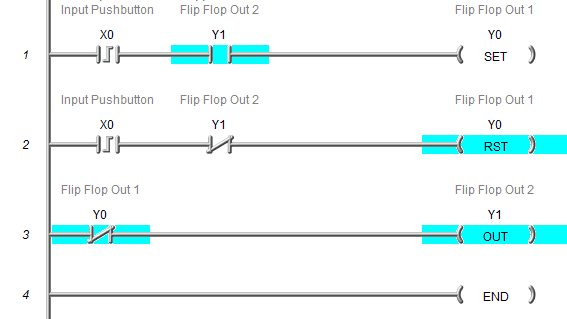
A flip-flop circuit in a PLC usually has one input and two outputs. When the input is activated, the two outputs alternately latch on/off opposite each other. It is used to toggle (latch) work on and off with just one input. In the PLC, it is a single input that will toggle an output on … Read more

Ultimate PLC Traffic Light Control: Stop Struggling Forever!

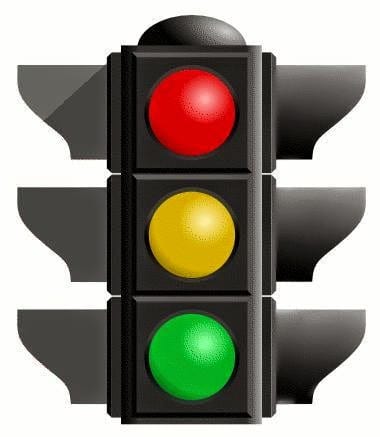
In part 1, we looked at writing PLC programs to control a traffic light using discrete bits and timed sequencing using indirect addressing. Part 2 used indirect addressing for inputs and output to control the program’s sequence of pneumatic (air) cylinders. Part 3 returned to the traffic light application and expanded our program significantly. We … Read more

Building a PLC Program Part 3 – Traffic Light

In part 1, we looked at writing PLC programs to control a traffic light using discrete bits and timed sequencing using indirect addressing. Part 2 used indirect addressing for inputs and output to control the program’s sequence of pneumatic (air) cylinders. We will now return to the traffic light application and expand our program significantly. … Read more

PLC Ladder Logic Programming – On/Off and Variable Range Types

This post is a further follow-up from my original ‘Here’s a Quick Way to Understand PLC Inputs and Outputs.’ There are two different kinds of PLC outputs, Discrete and analog. Discrete outputs are either ‘ON’ or ‘OFF’; 1 or 0. You can think of them as a single light bulb. Analog outputs have a range … Read more

PLC Discrete Inputs Tutorial – Normally Open vs Closed Contacts

This post is a further follow-up from my original ‘Here’s a Quick Way to Understand PLC Inputs and Outputs.’ There are two different kinds of PLC inputs, Discrete and analog. Discrete inputs are either ‘ON’ or ‘OFF’; 1 or 0. You can think of them as a single switch. Analog inputs have a range to … Read more

Free PLC Programming Secrets: Learn Without Hardware!

plc basics programmable logic controller

I have been writing PLC programs for over 20 years. I often get asked what the best way to learn PLC programming is. Programming in the way I was taught in college was with the Motorola 6809. (Yes, I know that I am dating myself) This was microprocessor programming, but it was the best way … Read more

How to Troubleshoot a PLC – Ladder Logic

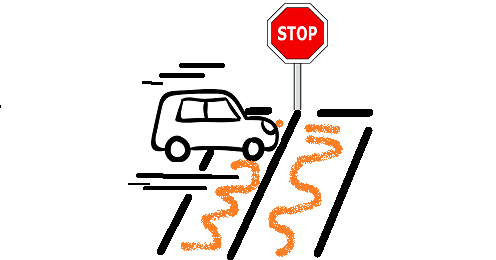
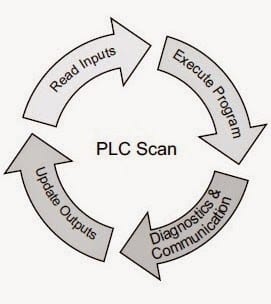
We will look at how to troubleshoot a plc racing condition. Two examples are explained in racing conditions in the PLC. The PLC will update only at the end of the program logic. Items set will not happen until the I/O is refreshed. How to trigger events when you want them is discussed. Your control … Read more