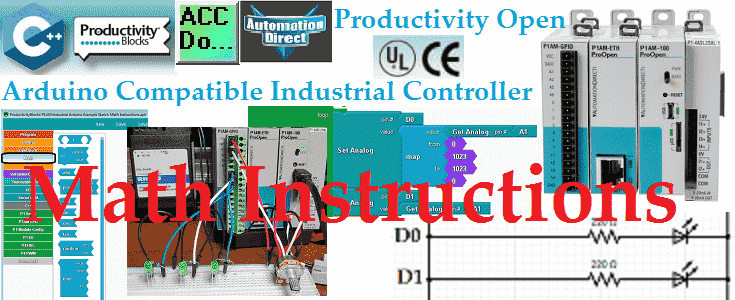
Essential P1AM Arduino Math: From Basics to Complex Operations

Math instructions in your Arduino sketches (programs) consist of arithmetic operations, compound operators, absolute, power, square root, sin, cos, tan, random, map and constrain. These instructions will be generally used with other instructions in your sketch. We will be looking at each of these instructions that are available using productivity blocks. A sample program will … Read more

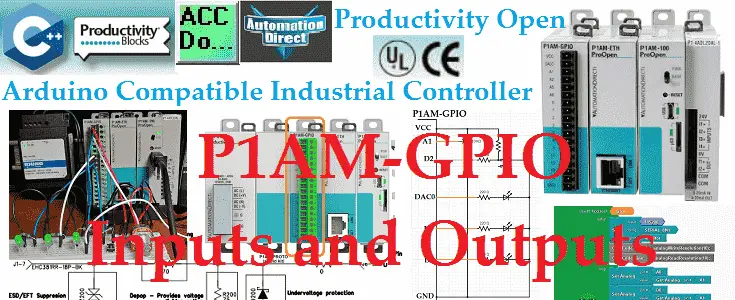
P1AM Industrial Arduino GPIO Inputs and Outputs

The P1AM-GPIO is an industrial rated shield for the P1AM-100 Arduino system. It provides a connection from most of the P1AM-100 GPIO pins to the front 18 position terminal block connector. We will be looking at the wiring and programming of this input and output industrial rated shield that mounts on the left side of … Read more

Click PLC Programming with Stride Field IO Modbus TCP Setup

We will now look at the Click PLC Modbus TCP remote io. The Click PLC can use remote inputs and outputs from Stride. The Stride Field I/O Modules are simple and compact. They provide an economical means to connect inputs and outputs to an Ethernet Modbus TCP communication network. Every module operates as a standalone … Read more

Stop Wiring DC Sensors Wrong: NPN vs PNP Made Simple

Wiring 3 wire DC sensors can be confusing. I recently received a question on PNP and NPN sensors. They wanted an explanation of what a sink is and how to wire one. Confusion over the Normally Open and Normally Closed function of the sensor is also a common question. Several diagrams will show a resistor … Read more

Universal Signal Conditioner and Isolator

Signal conditioners are used with analog current and voltage signals. They have the ability to change your input analog signal to another output analog signal. As an example, we can have 4-20mA analog input and change it to a 0-10VDC output signal so we can wire this into our PLC. Typically signal conditioners will also … Read more

Why Ultrasonic Sensors Outlast Every Other Switch on Your PLC

An ultrasonic sensor (switch) is able to detect object presence without physical contact (limit switch). No physical contact means that the switch has no parts that will wear out. The life span of the sensor is increased with less maintenance. An ultrasonic sensor will use sound waves to detect objects. These sound waves are at … Read more

Wiring a Capacitive NPN PNP Sensor to the Click PLC

A proximity sensor (switch) is able to detect object presence without physical contact like a limit switch. No physical contact means that the switch has no parts that will wear out. The life span of the sensor is increased with less maintenance. A capacitive proximity sensor will detect ferrous and non-ferrous objects. The sensor works … Read more

Wiring an Inductive NPN PNP Sensor to the Click PLC

We will now look at wiring an NPN and PNP inductive proximity sensor to the Click PLC. A proximity sensor (switch) is able to detect object presence without physical contact like a limit switch. No physical contact means that the switch has no parts that will wear out. The life span of the sensor is … Read more

Click PLC Wiring Secrets: Push Button & Switch Connection

We will now look at wiring a click plc with selector switch and pushbuttons. A push button (pushbutton) is a simple human interface for controlling some aspect of a machine or process. The push button requires a force to push the button to change the electrical operation from off to on or vice versa. The … Read more

Master PLC Programming: Essential Contact & Coil Secrets

Contact and coil instructions are in every PLC program. The Productivity Suite Software consists of more than 82 instructions divided into 13 categories for the PLC. Contacts and Coils are two of the categories of instructions. Contact instructions include NO / NC, NO Edge / NC Edge and Compare. Coil instructions include Out, Set, Reset, … Read more